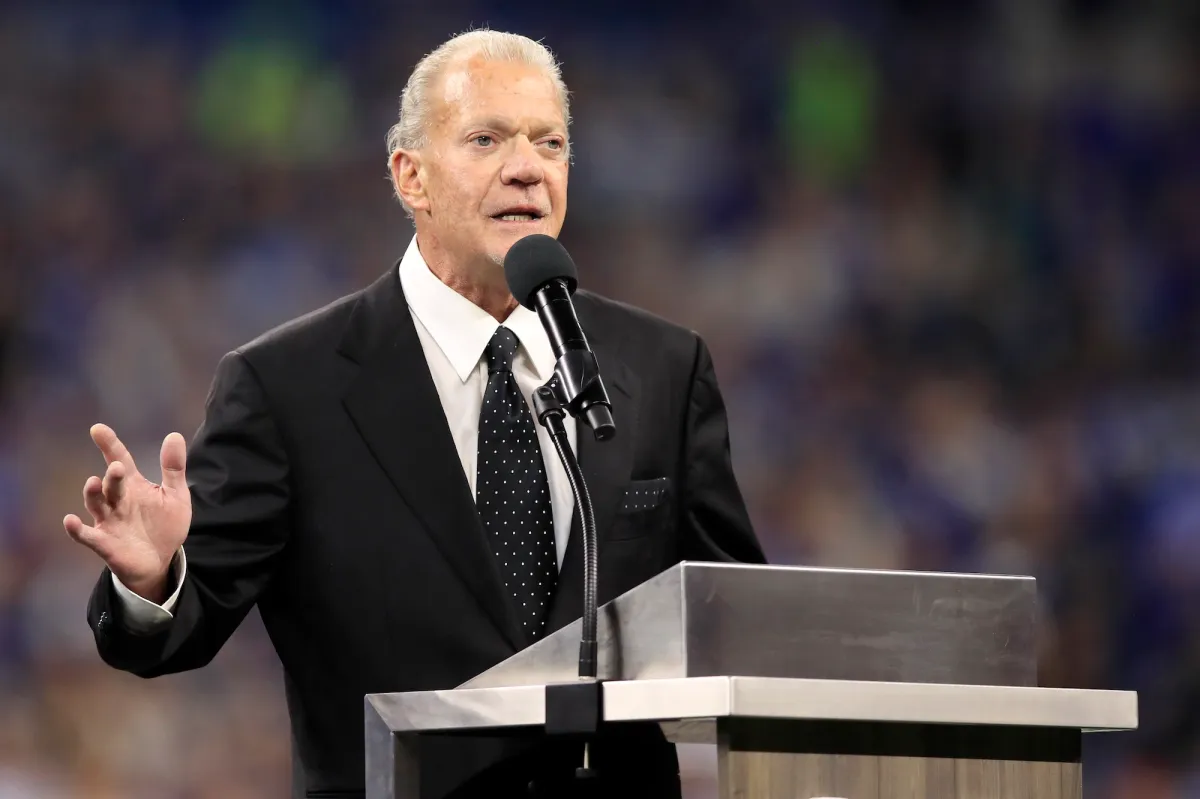


The FBI is investigating the death of former Indianapolis Colts owner Jim Irsay, as well as the doctor who provided him with prescription pain pills and ketamine near the end of his life, the Washington Post reported on Thursday, January 22.
A federal grand jury subpoena obtained by the Post asks for records regarding Irsay’s alleged “substance (illegal and prescription) use,” and his relationship with California addiction specialist Dr. Harry Haroutunian.
Irsay died in his sleep at age 65 on May 21, 2025. A death certificate, signed by Haroutunian, names his cause of death as cardiac arrest caused by acute pneumonia, with two heart conditions as contributing factors, according to the Indianapolis Star.
The Los Angeles County Department of Medical Examiner did not investigate Irsay’s death at the time or conduct an autopsy.
Colts Chief Legal Officer Dan Emerson confirmed to the Post on Thursday that it is aware of the FBI’s investigation, but that the Bureau had not contacted the team or served it with a subpoena.
“I do understand that there have been some subpoenas provided, but not to me, the Colts or any of our current employees,” he said.
Irsay, who took over as Colts owner in 1997 after the death of his father, Robert Irsay, was open about his addiction to painkillers since his struggles became public in 2002.
In 2014, he pleaded guilty to operating while intoxicated and was sentenced to a year of probation. The NFL fined him $500,000 and suspended him for six games as a result.
“A lot of people don’t understand the disease,” he told USA Today at the time. “They think you choose an addiction. At the same time, I’ve had many, many years of continual recovery. What’s really important is that you can be honest and talk about an illness.”
The late owner suffered multiple relapses in his final months, an August 2025 Washington Post investigation revealed. The Post reported that Irsay overdosed at least three times after February 2020, including twice in a 12-day span in late 2023 and early 2024. Haroutunian allegedly prescribed Irsay more than 200 opioid pills in the days before and later added ketamine to his treatment.
“I dedicated 18 months of my life to try to care for him…as a brother,” Haroutunian told the Post at the time. “We did everything we could to make him as comfortable as possible.”
His daughters, Carlie Irsay-Gordon, Casey Foyt and Kalen Jackson, declined to be interviewed for the outlet’s investigation but provided a statement asking for privacy. (Irsay shared his daughters with ex-wife Meg Coyle, to whom he was married from 1980 to 2013.)


“Our Dad was open about his battles with addiction and mental health. He never claimed to be perfect,” they wrote. “The media is not the place to address inquiries about information which is disputed, lacks essential context, or involves private medical matters.”
The added, “Our focus remains on honoring our Dad’s legacy, his decades of philanthropy, his loyalty to the Colts and its fans, and his passion for mental health advocacy, music, and second chances.”
Emerson also refused an interview at the time, saying, “We handled everything in an appropriate, professional, ethical and moral fashion…I really wish everybody would let my friend rest in peace.”