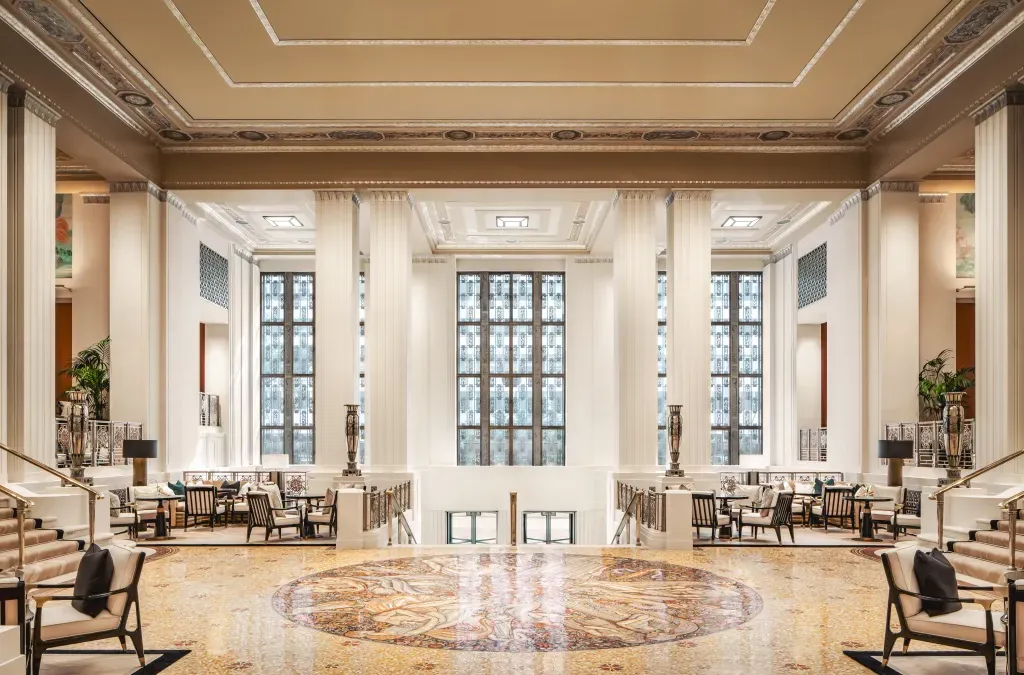


After years of meticulous restoration, the Waldorf Astoria New York has reopened its doors, unveiling a stunning transformation that blends Art Deco grandeur with modern refinement.
The historic Midtown Manhattan property, long considered one of the world’s most iconic hotels, now welcomes guests to reimagined accommodations, restored landmark interiors, and new culinary destinations that honor its storied legacy.
Originally opened in 1931, the Waldorf Astoria has played host to presidents, royals, and cultural icons. Now, following a sweeping overhaul led by architecture firm Skidmore, Owings & Merrill, the hotel returns with 375 guest rooms and 372 private residences — down from the original 1,400 rooms, allowing for expanded layouts and a more residential atmosphere. The redesign preserves the landmarked elements of the building while introducing state-of-the-art amenities and contemporary interiors.
“In many ways, Waldorf Astoria New York is the most important hotel in the world. It is the original luxury property and the place where luxury service was perfected. It not only holds a special place in Hilton’s history, but also in modern history,” said Chris Nassetta, president and CEO, Hilton. “We look forward to once again welcoming guests to experience its timeless charm and modern enhancements, as this hotel and Waldorf Astoria properties around the world set the standard for luxury stays.”
Interior designer Pierre-Yves Rochon spearheaded the guest room and public space transformation, employing a neutral, mineral-inspired palette, rich materials, and custom furniture to maintain the architectural clarity of the original Art Deco vision. Many spaces, such as the reception area, incorporate original materials — like marble from Peacock Alley — recontextualized for modern function and style.
Among the hotel’s most celebrated features is the return of Peacock Alley, long regarded as the social centerpiece of the Waldorf. The historic clock, originally created for the 1893 Chicago World’s Fair, once again stands in the center of the space, accompanied by the restored Steinway piano gifted to Cole Porter during his residency at the hotel.
Three new dining experiences are now open for reservations. Peacock Alley serves as both cocktail lounge and historical gathering space, with bar programs curated by mixologist Jeff Bell and cuisine led by Executive Chef Patrick Schaeffer. Lex Yard, an American brasserie by chef Michael Anthony, occupies a two-story space at Lexington and 50th. Yoshoku offers a refined, New York-style take on traditional Japanese kaiseki cuisine.
The property’s grand reopening will continue through the fall. On Sept. 1, more than 43,000 square feet of event space will reopen, including the Grand Ballroom, Astor Room, and Jade Room. The Guerlain Wellness Spa is also scheduled to open later this year.
Guests can now enter the hotel through three access points, including a restored private porte-cochère on 49th Street — the only one of its kind in Manhattan. Towering above Park Avenue is the newly restored “Spirit of Achievement” statue by Nina Saemundsson, a longtime symbol of the hotel since its original debut in the 1930s.



The building’s preservation marks one of the most ambitious adaptive reuse projects in New York City history, with more than 62,000 square feet of landmarked interiors restored in partnership with the city’s Landmarks Preservation Commission. Vibrant murals, decorative mosaics, and vintage details throughout the hotel were carefully conserved, some dating back to the 19th century.
In addition to its hotel offerings, the Waldorf Astoria Residences now offer condominium living high above the hotel floors. These residences, designed by Jean-Louis Deniot, range from studios to four-bedroom homes, many with private terraces. Residents enjoy exclusive amenities and priority access to hotel services, including a new turnkey furnishing option in partnership with B&B Italia Group.
With its doors once again open, the Waldorf Astoria New York resumes its place at the heart of the city’s luxury hospitality landscape — reborn for a new generation, but still rooted in the tradition that made it famous.