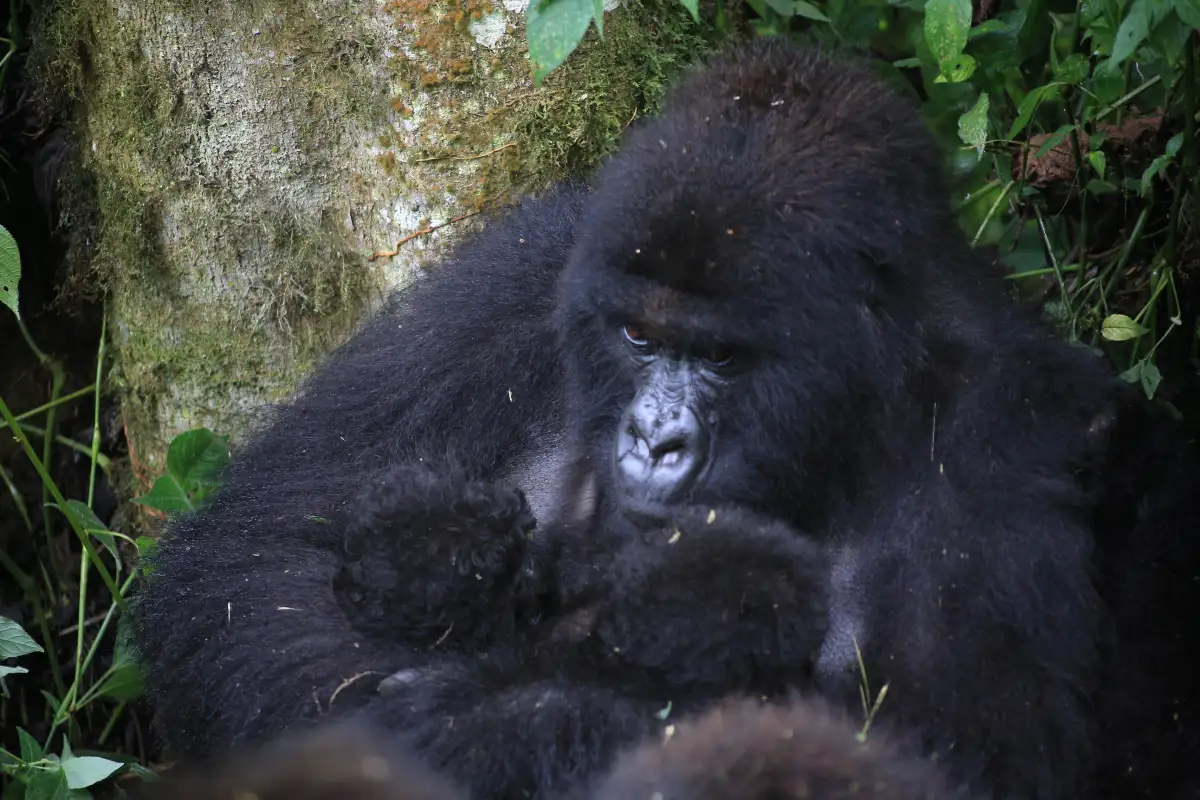


An estimated 1,050 to 1,063 mountain gorillas survive in the wild. Every birth matters — and twin births, which occur in less than 1% of all gorilla births, are nearly unheard of.
That’s why two sets of twins born three months apart at Virunga National Park in the eastern Democratic Republic of Congo have scientists and park officials calling the moment extraordinary.
“Two instances of twin births within 3 months is an extraordinary event and provides another vital indicator that dedicated conservation efforts, which have continued despite the current instability in eastern Congo, continue to support the growth of the endangered mountain gorilla population within Virunga National Park,” said Jacques Katutu, head of gorilla monitoring at Virunga National Park.
Virunga National Park Witnessed 2 Gorilla Twin Births Within 3 Months
The first set of twins — both males — was born in January 2026 to adult female Mafuko in the Bageni family. Those twins are now approximately 11 weeks old and are reported to be thriving.
A young blackback male — sexually mature but not yet a silverback — has been observed staying close to Mafuko, showing notable protective and supportive behavior toward the mother and infants.

A second set of twins arrived in early 2026 in the park’s Mikeno sector, born into the Baraka family. These twins are believed to be one female and one male, approximately two weeks old.
Their arrival brings the Baraka family’s total to 19 individuals and marks the ninth gorilla birth recorded in Virunga in 2026.
For context, eight mountain gorilla births were recorded in Virunga across all of 2025. The park has already surpassed that total.
“The arrival of twins among gorillas is a special occasion given their rarity,” Tara Stoinski, CEO and chief scientific officer of the Dian Fossey Gorilla Fund, told CBS News.
“From our nearly 60-year mountain gorilla database… we know that they occur in less than one percent of births,” she added.
Biologically, twins most likely result from hyper-ovulation, where two or more eggs are released and fertilized at the same time. Some observations suggest twins may be more likely when the mother is in particularly good physical condition.
What the Gorilla Twin Births Mean for Conservation Efforts
Mountain gorillas (Gorilla beringei beringei) are a subspecies of the eastern gorilla. They live in close-knit family groups led by a dominant silverback male, alongside several females and their offspring.
Around 350 gorillas were recorded in Virunga alone as of 2021.
Their numbers increased by approximately 3% per year between 2010 and 2016, according to WWF’s 2024 Living Planet Report.
“The mountain gorillas were actually faring extraordinarily well,” Virunga director Emmanuel de Merode told Mongabay. “The numbers increased because of an enormous effort on the part of Congo’s rangers.”
Virunga National Park is Africa’s oldest national park, founded in 1925, and a UNESCO World Heritage Site. The Virunga mountains host one of only two known wild populations of mountain gorillas.
The park’s Mikeno sector features a diverse mix of vegetation types and altitude zones that may support favorable ecological conditions for gorillas.
Gorilla Twin Births Aren’t Easy on the Mother
Twin births place heavy physical demands on the mother. She must carry two infants, making movement harder — especially in the early weeks.



Nursing two infants also requires significantly more milk production, which is energetically very costly. Strong social support from within the group can improve the chances of survival.

In the Bageni family, that dynamic is already visible: the young blackback male staying close to Mafuko and her twins appears to be providing that kind of support.
Field teams are closely monitoring both sets of twins during this critical early period.